

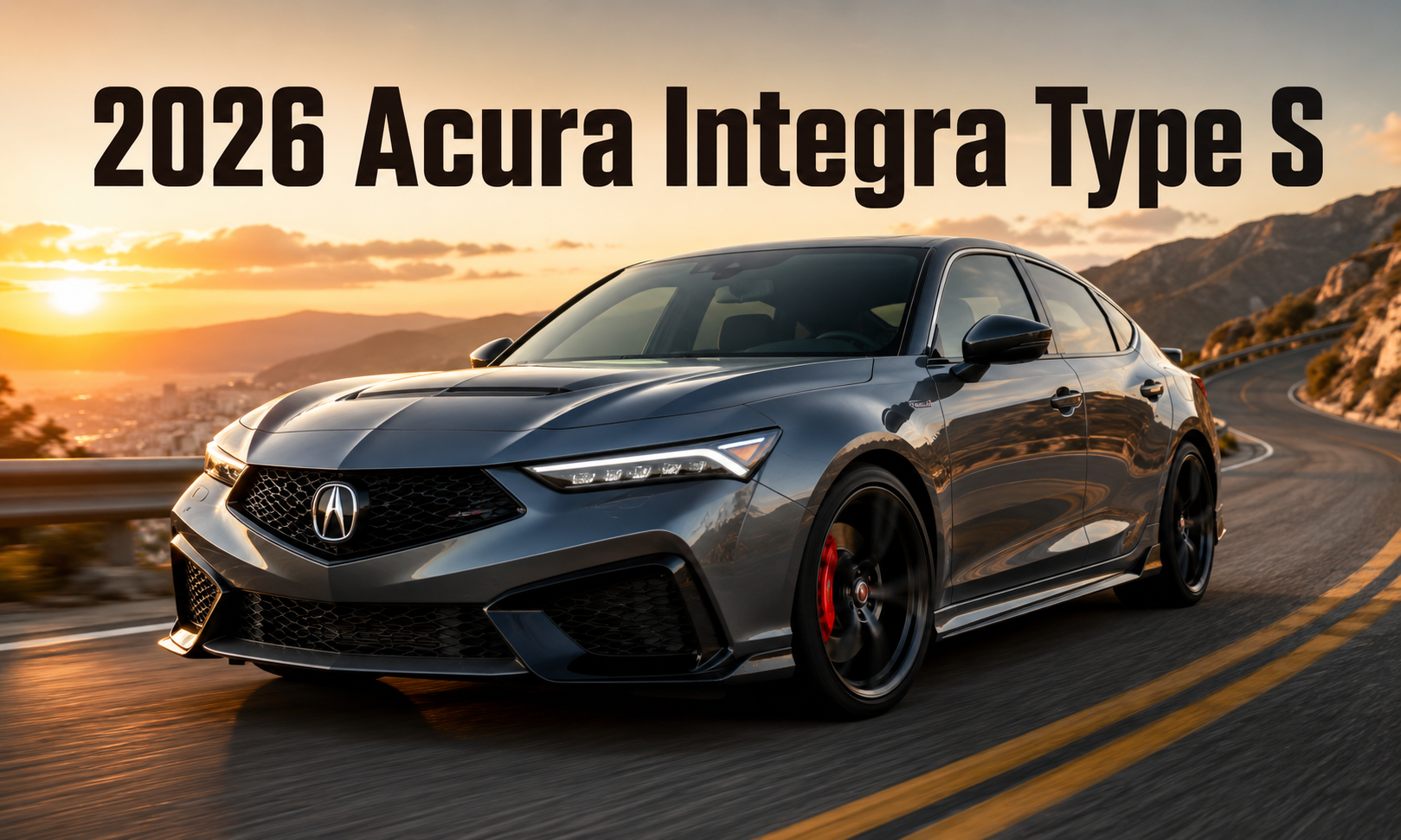
A practical assessment of price, performance, manual-only ownership, hatchback utility, winter costs, track hardware, and whether buying used makes more sense
| 2026 Integra Type S fact | Details |
| MSRP | $53,900 before the $1,295 destination charge |
| Delivered starting price | $55,195 |
| Engine | Turbocharged 2.0-liter VTEC four-cylinder |
| Output | 320 horsepower and 310 lb-ft of torque |
| Transmission | Close-ratio six-speed manual with rev matching |
| Drivetrain | Front-wheel drive with a helical limited-slip differential |
| Chassis hardware | Dual-axis front struts and adaptive dampers |
| Brakes and tires | Brembo four-piston front calipers and 265/30ZR19 summer tires |
| EPA economy | 21 mpg city, 28 mpg highway, and 24 mpg combined |
| Cargo and seating | 24.3 cubic feet and seating for four |
| Tested performance | 0 to 60 mph in 5.1 seconds and 1.02 g of skidpad grip |
Key Takeaways
- The Type S is one of the few new performance cars that combines a manual transmission, real track hardware, and a large liftback cargo opening.
- It is quick rather than brutally fast, but its steering, brakes, differential, and chassis balance are the main reasons to buy it.
- The delivered starting price is $55,195, and the car is largely one well-equipped trim rather than a complicated option ladder.
- Premium 93-octane fuel, summer tires, four-seat capacity, and the lack of an automatic transmission narrow its audience.
- Because the 2026 model is unchanged, a lightly used 2024 or 2025 Type S may deliver nearly the same experience for less money.
2026 Acura Integra Type S is best understood as a one-car performance solution rather than a luxury sedan with extra horsepower. It can carry luggage, groceries, bicycles, or track-day gear through its liftback, then deliver serious braking, grip, and driver involvement without becoming exhausting on a normal commute.
The car is also unusually focused. It is front-wheel drive, manual only, equipped with summer tires, and limited to four seats. Those decisions improve the driving experience but make it less universally convenient than an automatic AWD rival.
| Verdict in 30 seconds
Buy the Type S when you want one vehicle for commuting, weekend roads, practical cargo, and occasional track use. Skip it when you need an automatic, regular winter capability without a second tire set, five seats, or the fastest possible acceleration for the price. |
What Does the Price Include?
Acura lists the Type S at $53,900 before destination, or $55,195 after the current $1,295 destination charge. Unlike many luxury performance cars, it does not require a long list of packages to reach its advertised performance.
Acura’s official 2026 Integra pricing and specifications confirm the 320-hp engine, 310 lb-ft of torque, six-speed manual, limited-slip differential, adaptive dampers, 21/28/24 mpg ratings, 24.3 cubic feet of cargo room, and four-seat capacity.
The main ways to raise the price are premium paint, dealer-installed accessories, different 19-inch wheels, carbon-fiber exterior parts, and dealer-added protection products. Buyers should request an itemized buyer’s order because accessories and markups can erase the model’s value advantage.
Why It Is More Than a Powerful Integra
| Performance component | What it does | Why it matters on the road |
| Helical limited-slip differential | Sends torque to the front tire with more grip | Reduces inside-wheel spin and improves corner exits |
| Dual-axis front struts | Separates steering and suspension forces | Helps control torque steer under power |
| Adaptive dampers | Changes suspension response by drive mode | Allows a calmer commute and firmer track setup |
| Brembo front brakes | Uses four-piston calipers and 13.8-inch rotors | Improves heat capacity and repeated stopping |
| 265-section summer tires | Provides a wide, sticky front contact patch | Supports strong grip but requires winter planning |
| Active exhaust | Changes sound through drive modes | Makes Sport+ dramatic without forcing maximum volume every day |
The Type S also uses a lightweight single-mass flywheel, a close-ratio gearbox, stronger cooling, wider bodywork, and a vented hood. Acura deletes the moonroof, which saves weight high in the body and supports chassis rigidity.
Is Manual Only a Strength or a Problem?
The six-speed manual is one of the best reasons to buy the car. The clutch is approachable, the shifter is precise, and automatic rev matching can smooth downshifts. Drivers can disable rev matching when they prefer full control.
The limitation is obvious: there is no automatic version. Heavy traffic, multiple drivers in one household, physical mobility needs, or a preference for launch consistency may make the Audi S3, BMW M235, Golf R, or another automatic performance car easier to own.
| Test the clutch before deciding
A short dealership drive is not enough. Use stop-and-go traffic, a hill start, a highway merge, and a parking maneuver to decide whether the manual fits your daily routine. |
Measured Performance: Fast Enough, but Chassis First
The supplied Car and Driver Integra Type S review recorded 0 to 60 mph in 5.1 seconds, a 13.7-second quarter-mile at 105 mph, 1.02 g of skidpad grip, and a 153-foot stop from 70 mph. The car also returned 31 mpg during the 75-mph highway test.
| Measured result | Figure | Buyer meaning |
| 0 to 60 mph | 5.1 seconds | Quick, but traction limits the launch |
| Quarter-mile | 13.7 seconds at 105 mph | Strong real-world passing performance |
| Skidpad | 1.02 g | Serious cornering capability |
| 70 to 0 mph | 153 feet | Track-ready braking performance |
| 75-mph highway economy | 31 mpg | Better touring efficiency than the EPA highway figure |
| Manufacturer top speed | 167 mph | Demonstrates high-speed capability, not a public-road target |
A rear-drive or AWD rival may launch harder, but the Acura’s strength appears after the first corner. Steering accuracy, front-end grip, brake feel, and the differential make it rewarding at legal speeds and repeatable during track sessions.
Can It Really Serve as Your Only Car?
| Use case | Score | What works | What may frustrate you |
| Daily commute | 8/10 | Comfort mode, easy clutch, good visibility | Road noise and no automatic |
| Road trip | 8/10 | 31-mpg tested highway result and large hatch | Small fuel tank and firm seats for some drivers |
| Family use | 6/10 | Useful rear legroom and cargo opening | Four seats, no rear vents, no rear seat heaters |
| Winter | 5/10 | Limited-slip differential helps traction | Summer tires require replacement or a second wheel set |
| Track day | 9/10 | Cooling, brakes, dampers, differential, and grip | FWD launch and tire wear |
| Urban parking | 8/10 | Compact footprint and hatchback usefulness | Wide body and low-profile wheels |
Interior and Cargo: Practical, Not Fully Luxurious
The liftback is a major advantage. Acura rates cargo capacity at 24.3 cubic feet, which is more useful than the small trunk openings in many sport sedans. The rear seats fold for bulky cargo, and the wide opening makes it easier to load wheels, luggage, home-improvement supplies, or outdoor gear.
The cabin includes a 9-inch touchscreen, wireless Apple CarPlay and Android Auto, wireless charging, a 10.2-inch digital instrument cluster, a head-up display, and a 16-speaker ELS Studio 3D audio system.
The premium impression is less convincing in back. The Type S seats four rather than five, and the rear passengers do not receive air vents or heated seats. Some interior pieces also reveal the car’s Civic foundation, although the controls are easy to use and build quality is strong.
Type S or Civic Type R?
| Priority | Integra Type S | Civic Type R |
| Exterior personality | More understated and premium | More aggressive and track-focused |
| Ride and sound | More relaxed settings and active exhaust character | Sharper, more intense experience |
| Cabin | ELS audio, head-up display, Acura design details | Simpler performance-focused presentation |
| Track focus | Highly capable but road-biased | More uncompromising |
| Value question | Pay more for refinement and equipment | Pay for maximum performance focus |
The Type S is the better one-car choice when audio quality, styling restraint, hatch utility, and a wider comfort range matter. The Type R is the stronger choice when lap-time focus and the most direct version of the platform are the priorities.
Fuel, Tires, Warranty, and Ownership Costs
Acura recommends premium 93-octane fuel. EPA ratings are 21 mpg city, 28 mpg highway, and 24 mpg combined, and the tank holds 12.4 gallons. The car can be efficient on the highway, but frequent boost and high-rpm driving increase fuel use quickly.
The standard Michelin Pilot Sport 4S tires are excellent in warm conditions but should not be used in freezing temperatures or snow. Buyers in cold climates should budget for performance winter tires or a complete second wheel-and-tire package.
Warranty coverage includes four years or 50,000 miles for the vehicle and six years or 70,000 miles for the powertrain. Acura also includes scheduled maintenance for one year or 12,000 miles. Track use, consumables, tires, brake pads, and damage are not automatically covered.
Should You Buy New or Used?
The Type S entered production for 2024 and continues into 2026 without a meaningful mechanical update. That makes a clean 2024 or 2025 example especially attractive when it has not been modified, abused, or repeatedly tracked.
Buying new provides the full warranty, known history, exact color choice, and current financing options. Buying used may save money, but inspect the clutch, second-gear engagement, front tires, wheels, brake wear, underside, alignment, paint, and aftermarket engine software.
Who Should Buy It?
- A manual-transmission driver who needs real cargo space
- An enthusiast who wants occasional track capability without owning a second car
- A commuter who values steering and chassis feel more than luxury isolation
- A buyer who prefers a restrained appearance over a large rear wing
- A warm-climate driver or someone willing to buy a winter tire set
Skip it when you need an automatic, AWD, five seats, a quiet luxury cabin, inexpensive all-season tires, or the quickest stoplight launch for approximately $55,000.
Frequently Asked Questions
How much is the 2026 Integra Type S?
The MSRP is $53,900. Adding the $1,295 destination charge produces a delivered starting price of $55,195.
Does it come with an automatic transmission?
No. Every Type S uses a six-speed manual transmission.
Is it AWD?
No. It is front-wheel drive with a helical limited-slip differential.
How fast is it?
Car and Driver recorded 0 to 60 mph in 5.1 seconds and a 13.7-second quarter-mile at 105 mph.
Is it practical?
Yes for cargo, thanks to the 24.3-cubic-foot liftback. It seats only four and lacks several rear-passenger amenities.
Is the 2026 model different from 2025?
It is largely unchanged, which makes lightly used 2024 and 2025 examples worth considering.
Final Verdict
The 2026 Integra Type S is not the fastest car near its price, and it is not the most luxurious. Its appeal comes from combining one of the best manual powertrains in a modern front-wheel-drive car with serious brakes, excellent grip, adjustable ride quality, and unusually useful cargo space.
Buy it when you want one car that makes ordinary roads enjoyable and can handle a track day without major preparation. Consider a used example when the price difference is meaningful, because the 2026 model preserves the same core formula
