

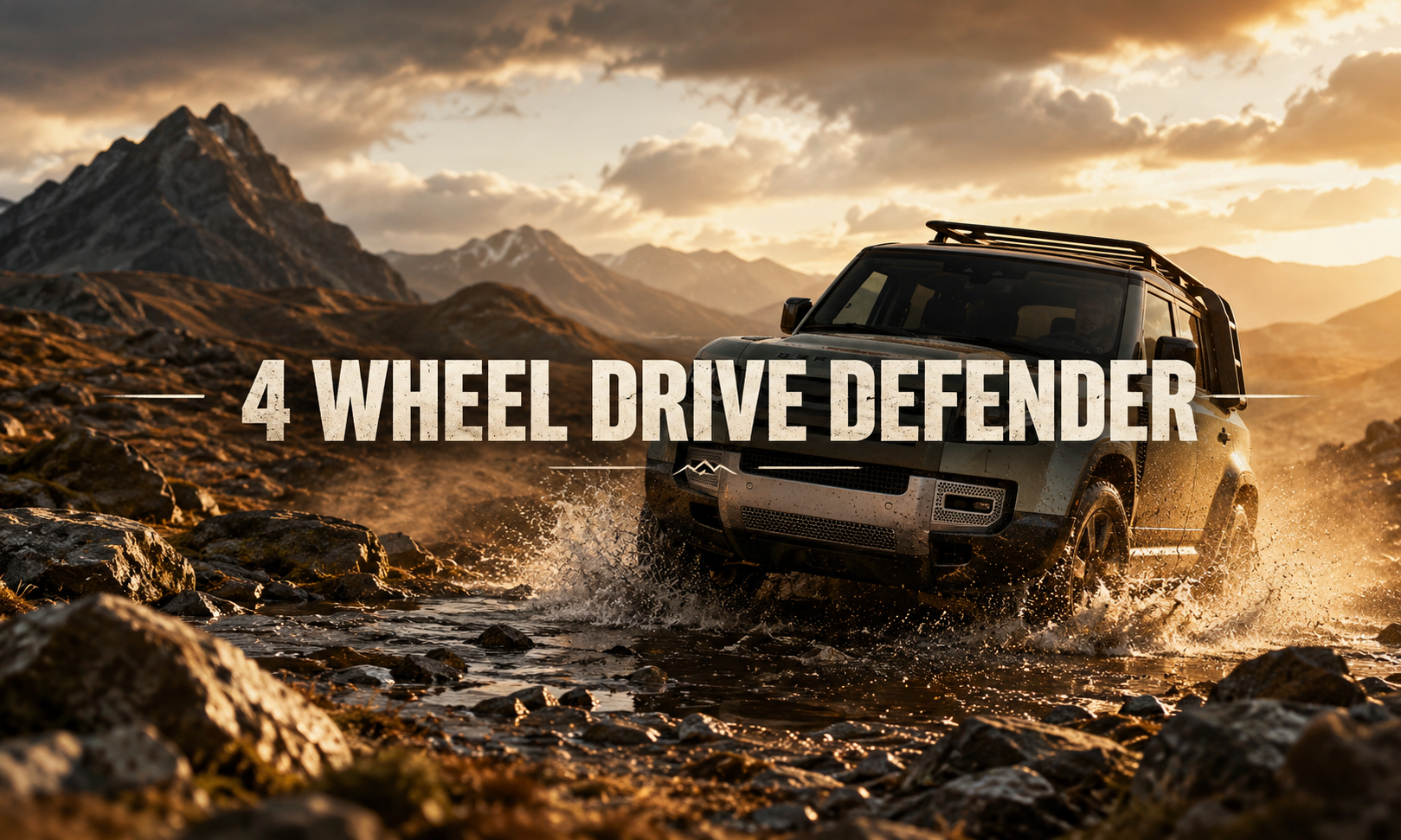
A practical guide to permanent 4WD, low range, Terrain Response, body styles, engines, towing, tires, and off-road options in the 2026 Defender lineup
| 2026 Defender fact | Details |
| Drive system | Permanent four-wheel drive with an eight-speed automatic and twin-speed transfer case |
| Body styles | Defender 90, Defender 110, Defender 130, and Defender OCTA |
| Seating | Five to eight seats, depending on body and configuration |
| Engine range | 296-hp turbo four, 395-hp mild-hybrid inline-six, 518-hp supercharged V8, and 626-hp OCTA V8 |
| 2026 price span | $65,450 to $160,250 as listed by Car and Driver |
| Maximum ground clearance | Up to approximately 11.5 inches with the appropriate suspension setting |
| Maximum wading depth | About 35.4 inches for mainstream Defender configurations |
| Maximum towing | Up to 8,200 pounds when properly configured |
| Infotainment | 13.1-inch Pivi Pro touchscreen for the updated 2026 cabin |
| Warranty | Four years or 50,000 miles for the limited and powertrain warranties |
Key Takeaways
- Every modern Defender uses permanent four-wheel drive rather than a light-duty crossover system.
- Low range, Terrain Response, differential control, and tires matter more off road than horsepower.
- The Defender 110 inline-six best balances room, comfort, towing, and trail capability.
- The Defender 90 is easier to place on tight trails, while the 130 is the better people carrier but has more body to manage off road.
- Wheel and tire choice can change real capability more than an expensive appearance package, so buyers should prioritize sidewall, tread, and full-size spare compatibility.
4 wheel drive Defender searches usually come from buyers who want more than a luxury SUV with an adventurous shape. The modern Defender answers that need with permanent drive to both axles, selectable low range, terrain-specific software, substantial ground clearance, and the ability to manage water, loose climbs, towing, and broken surfaces without giving up everyday comfort.
Every version has four-wheel drive. The buying decision is which wheelbase, engine, suspension, differential, tire, and option combination matches the job.
| Best all-around setup
For most buyers, the Defender 110 with the 395-hp inline-six, electronic air suspension, appropriate all-terrain tires, a full-size spare, and the off-road hardware available for the chosen trim delivers the strongest balance of road comfort and genuine trail capability. |
Is the Defender 4WD or AWD?
Both labels appear in listings because permanent four-wheel drive can be categorized as all-wheel drive in general specification databases. Mechanically, the Defender is closer to a traditional full-time 4×4 than to a typical crossover AWD system. It continuously powers both axles and includes a transfer case with high and low ranges.
Low range multiplies torque for crawling, steep descents, sand, recovery, and controlled trailer maneuvering. A center differential permits normal pavement use and can be managed electronically when traction falls.
Land Rover originally described the current generation with a fully independent suspension, permanent four-wheel drive, a twin-speed transfer case, and configurable Terrain Response. The modern unibody structure is different from the ladder-frame classic Defender, but it still uses hardware intended for sustained off-road work rather than occasional slippery-road assistance.
What the Main 4WD Components Actually Do
| Component | Function | When it helps |
| Permanent four-wheel drive | Sends power through the driveline to both axles continuously | Wet roads, snow, gravel, trails, towing, and mixed surfaces |
| Twin-speed transfer case | Provides high range and torque-multiplying low range | Rock crawling, steep grades, sand, recovery, and slow trailer work |
| Center differential control | Manages torque between front and rear axles | Cross-axle situations and changing traction |
| Active rear differential | Varies or locks torque across the rear axle when fitted | Climbs, ruts, mud, and situations with a lifted wheel |
| Terrain Response | Coordinates throttle, transmission, differentials, traction control, steering, and suspension | Grass, gravel, snow, mud, ruts, sand, rocks, and wading |
| Air suspension | Raises clearance and improves approach, breakover, and departure geometry | Deep ruts, rocks, water crossings, and loading access |
Not every trim includes every advanced item as standard. The rear differential, air suspension, Terrain Response 2, tow technology, and off-road packages can depend on body style, trim, engine, and build date. A window sticker or factory build sheet is more reliable than a dealer listing headline.
Which Defender Body Style Works Best?
| Body | Main strength | Tradeoff | Best buyer |
| Defender 90 | Short wheelbase and compact trail footprint | Two-door access and limited cargo space | Solo drivers, couples, and tight-trail users |
| Defender 110 | Best balance of room, maneuverability, and capability | Cargo space is not class-leading with every seat in use | Most families, tow users, and mixed road or trail driving |
| Defender 130 | Up to eight seats and more total cargo flexibility | Longer rear overhang and more length to manage off road | Large families and expedition travel |
| Defender 130 Outbound | Five-seat layout prioritizes cargo volume | No third row | Gear-heavy travel, dogs, camping, and work use |
| Defender OCTA | Extreme performance suspension and 626-hp V8 | Very high price and running costs | Buyers seeking maximum speed and broad terrain performance |
The 90 is agile but compromised for access and luggage. The 110 is the easiest recommendation for normal family, towing, and trail use. Choose the 130 when passengers or expedition gear matter more than compact trail geometry.
Which Engine Makes Sense for Four-Wheel-Drive Use?
| Engine | Output | Character | Best use |
| 2.0-liter turbo four | 296 hp | Adequate, lighter, and least expensive | Urban use, lighter loads, and value-focused 90 buyers |
| 3.0-liter inline-six | 395 hp | Smooth, flexible, and well matched to the chassis | Best overall choice for 110 or 130 ownership |
| 5.0-liter supercharged V8 | 518 hp | Fast, dramatic, and thirsty | Sound, speed, and premium road use |
| 4.4-liter twin-turbo V8 | 626 hp in 2026 OCTA | Extremely quick with special 6D Dynamics suspension | High-performance driving across mixed terrain |
The supplied Car and Driver Defender review rates the 2026 model 8 out of 10 and lists a $65,450 to $160,250 price range. It reports 296, 395, 518, and 626 horsepower depending on engine, plus 0-to-60-mph results of 6.2 seconds for an inline-six Defender 130, 4.4 seconds for a V8 Defender 90, and 3.7 seconds for the OCTA.
More power does not automatically improve slow off-road control. Low gearing, tire grip, throttle calibration, suspension travel, and differential management determine whether the vehicle can maintain progress without excessive wheelspin. The inline-six is usually the rational upgrade because it improves towing and passing performance without the V8 purchase price or fuel demand.
Why Tires Matter More Than Most Options
A Defender on low-profile street tires can be less useful on rocks, snow, or mud than a cheaper model on suitable all-terrain tires. Taller sidewalls improve impact protection, while aggressive tread adds noise and rolling resistance.
Confirm matching spare diameter, load and speed ratings, winter certification, and brake clearance. Expedition-style accessories cannot compensate for unsuitable tires.
| Do not select low range on dry pavement for ordinary driving
Use high range for normal paved-road travel. Low range is for slow, demanding terrain or controlled maneuvering. Follow the owner manual when shifting ranges and never assume a drive mode can overcome poor tire grip or unsafe water depth. |
How Capable Is It Off Road?
Land Rover publishes up to 35.4 inches of wading depth for the Defender 110 and describes Terrain Response 2 as an automatic system that adjusts vehicle settings for road, mud, snow, and other surfaces. The 110 can also be configured to tow up to 8,200 pounds and offers up to 69.1 cubic feet of cargo space behind the first row.
The official Defender 110 capability overview also lists a 260-pound dynamic roof-load rating, a 661-pound static roof-load rating, available Advanced Tow Assist, and a 10,000-pound winching capability with the appropriate equipment. These figures should always be checked against the exact vehicle, accessories, load, and owner documentation.
Car and Driver reports up to 11.5 inches of ground clearance. That is useful, but clearance is only one part of off-road geometry. Wheelbase, overhangs, tire diameter, suspension setting, payload, and the line chosen by the driver all affect whether the vehicle clears an obstacle.
Road Comfort and Everyday Compromises
The Defender earns its premium price by behaving more calmly on pavement than many traditional off-road SUVs. Independent suspension, accurate steering, a strong body structure, and available air springs help it absorb broken roads without the constant movement associated with some solid-axle 4x4s.
The compromises include weight, width, tire cost, electronics, and fuel economy. Car and Driver lists many four- and six-cylinder versions near 18 mpg city and 21 to 23 mpg highway, while V8 models can fall to the mid-teens.
The side-hinged rear door needs clearance behind the SUV. The 90 has little occupied-seat luggage room, the 110 is versatile with folded seats, and the 130 carries the most people and gear.
Best Configurations by Use Case
| Use case | Recommended direction | Reason |
| Daily driving plus weekend trails | Defender 110 inline-six | Balanced power, cabin space, turning needs, and capability |
| Tight technical trails | Defender 90 with suitable tires | Shorter wheelbase and easier obstacle placement |
| Family road trips and towing | Defender 110 or 130 inline-six | More room and up to 8,200 pounds of towing when configured correctly |
| Camping with bulky gear | Defender 130 Outbound | Five-seat layout prioritizes cargo |
| Snow and unpaved-road travel | 110 with winter-rated tires | Permanent 4WD helps, but tires provide the essential grip |
| Maximum performance | Defender OCTA | 626-hp V8 and specialized 6D Dynamics chassis |
New or Used Defender?
A one- to three-year-old Defender can provide similar 4WD hardware for less. Verify warranty, recalls, software, air suspension, transfer-case and differential operation, leaks, tires, wheels, underbody damage, and water or sand exposure.
Inspect aftermarket wheels, roof loads, winch wiring, suspension changes, recovery points, and underbody protection. Modified vehicles may not retain full warranty coverage.
Frequently Asked Questions
Does every Defender have four-wheel drive?
Yes. The current Defender lineup uses permanent drive to both axles. Exact differential, suspension, and terrain-control equipment varies by specification.
Which Defender is best for most people?
The Defender 110 with the 395-hp inline-six is the strongest general recommendation because it balances space, performance, towing, and trail maneuverability.
Is the Defender 90 better off road than the 110?
It can be easier on tight trails because of its shorter wheelbase, but tires, differential equipment, suspension, and driver judgment remain critical.
How much can a Defender tow?
Properly equipped 90, 110, and 130 models can be rated up to 8,200 pounds. Confirm the exact engine, hitch, brakes, payload, and VIN-specific documentation.
Final Verdict
The Defender is more than a luxury SUV with an all-wheel-drive badge. Its permanent four-wheel-drive system, low range, terrain software, available differential hardware, air suspension, wading ability, and towing capacity give it genuine capability beneath the design appeal.
A Defender 110 inline-six on suitable tires is the smartest all-around choice. Choose the 90 for tight trails, the 130 for people or gear, and the OCTA for extreme performance.
