

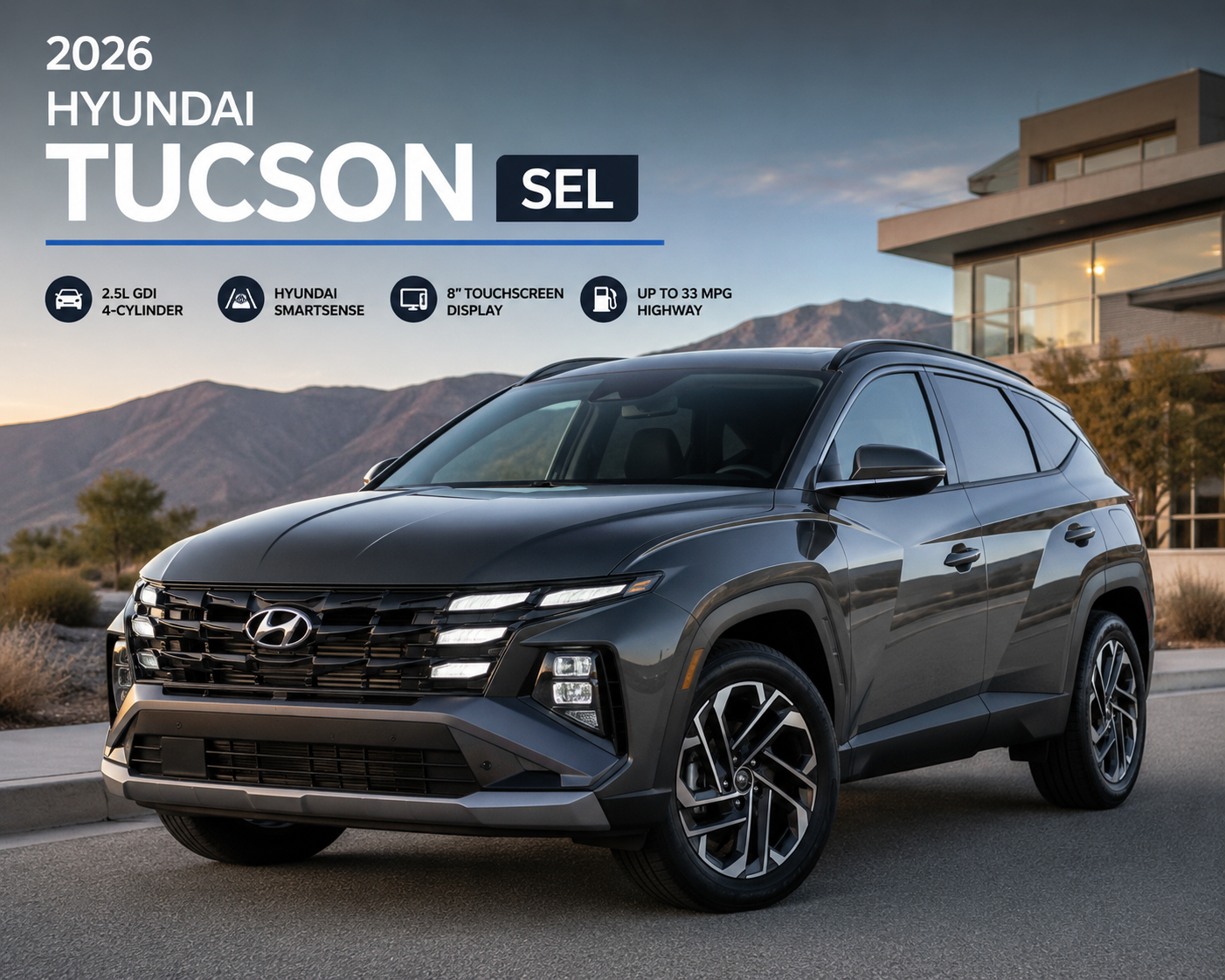
A practical comparison of price, standard features, FWD versus AWD, gasoline versus hybrid costs, performance, space, safety, and the trims above it
| 2026 Tucson SEL fact | Details |
| Base MSRP | $30,800 before freight, taxes, title, and license |
| Approx. price with current freight | About $32,400 if the $1,600 Tucson freight charge applies |
| Engine | 2.5-liter naturally aspirated four-cylinder |
| Output | 187 horsepower and 178 lb-ft of torque |
| Transmission | Eight-speed automatic |
| Drivetrains | Front-wheel drive or optional HTRAC all-wheel drive |
| EPA economy, FWD | 25 mpg city, 33 mpg highway, 28 mpg combined |
| EPA economy, AWD | 24 mpg city, 30 mpg highway, 26 mpg combined |
| Cargo capacity | 38.7 cubic feet behind rear seats and up to 74.8 cubic feet folded |
| Towing | Up to 2,750 pounds with trailer brakes under Hyundai’s current 2026 specifications |
| Best reason to buy | Useful comfort features without moving into upper-trim pricing |
Key Takeaways
- The SEL adds the comfort features most owners notice every day, including heated front seats, dual-zone climate control, wireless charging, and a hands-free liftgate.
- The 187-hp gas engine is smooth and quiet but slow, making the Hybrid SEL worth comparing before signing.
- FWD is the value and fuel-economy choice, while AWD is most useful for regular snow, steep roads, or loose surfaces.
- SEL Plus costs only $500 more before freight, so the exact equipment difference and dealer inventory deserve close attention.
- Hyundai backs the Tucson with one of the strongest warranty and complimentary-maintenance packages in the compact SUV class.
| Verdict in 30 seconds
The SEL is the sensible gas-powered Tucson for most buyers. It avoids the sparse feel of a base model and includes genuinely useful comfort equipment. However, the new Hybrid SEL costs only about $1,600 more before freight, delivers more power, and is rated at 38 mpg combined, so higher-mileage drivers should compare both before choosing. |
2026 Hyundai Tucson SEL sits near the center of Hyundai’s compact SUV lineup, but its value depends on more than the trim name. It must be compared with the nearly priced SEL Plus, the better-equipped SEL Premium, and the newly affordable Hybrid SEL before it can be called the sweet spot.
For a buyer who wants a roomy, quiet, easygoing crossover and does not care about quick acceleration, the gas SEL makes sense. It delivers the Tucson’s strongest everyday qualities without forcing the owner into leatherette seating, larger wheels, premium audio, or top-trim driver technology.
What Does the SEL Add?
The SEL is not merely an appearance package. It adds 18-inch alloy wheels, stain-resistant cloth seating, heated front seats, dual automatic temperature control, wireless device charging, and a hands-free smart liftgate with automatic opening. These are features families and commuters use more often than decorative trim.
Hyundai’s official 2026 Tucson SEL page lists a $30,800 MSRP before freight and highlights the heated seats, climate control, liftgate, charging pad, cloth upholstery, and available AWD. Dealer-installed accessories and premium paint can raise the sticker beyond the advertised starting figure.
| Feature area | SEL equipment | Why it matters |
| Comfort | Heated front seats and dual-zone climate control | Useful for couples and families with different temperature preferences |
| Cargo access | Hands-free smart liftgate | Helpful when carrying groceries, luggage, or a child |
| Phone use | Wireless charging plus wireless smartphone integration | Reduces cable clutter during daily driving |
| Wheels | 18-inch alloys | Better ride and tire cost than the largest upper-trim wheels |
| Seating | Stain-resistant cloth | Practical for children, pets, and everyday wear |
| Drivetrain | Optional HTRAC AWD | Adds traction when weather or road conditions require it |
Where the SEL Fits in the 2026 Price Ladder
| Gas trim | Base MSRP | Gap from SEL | Buyer role |
| SE | $29,450 | -$1,350 | Lowest price and basic transportation |
| SEL | $30,800 | Baseline | Core comfort and convenience value |
| SEL Plus | $31,300 | +$500 | Small step for additional styling or equipment |
| XRT | $33,475 | +$2,675 | Rugged appearance and adventure theme |
| SEL Premium | $33,800 | +$3,000 | More cabin technology and upscale materials |
| Limited | $39,425 | +$8,625 | Maximum gas-model luxury and driver assistance |
The $500 gap to SEL Plus is small enough that buyers should compare physical window stickers rather than assuming the SEL is automatically cheaper after dealer discounts. SEL Premium is the more meaningful upgrade when H-Tex seating, a more advanced display package, and extra convenience equipment matter.
Gas SEL Versus Hybrid SEL
The new front-wheel-drive Hybrid SEL starts at $32,400 before freight, only $1,600 above the gas SEL. It produces 231 combined horsepower and carries a 38-mpg combined EPA estimate, compared with 187 horsepower and 28 mpg combined for the gas SEL FWD.
| Decision point | Gas SEL FWD | Hybrid SEL FWD | Advantage |
| Base MSRP | $30,800 | $32,400 | Gas by $1,600 |
| Output | 187 hp | 231 combined hp | Hybrid |
| Combined MPG | 28 | 38 | Hybrid |
| Transmission feel | Conventional 8-speed automatic | 6-speed automatic hybrid system | Personal preference |
| Best buyer | Lower annual mileage and simpler purchase | Commuter or driver keeping the SUV several years | Depends on use |
At 12,000 miles per year and $3.50 per gallon, the gas SEL at 28 mpg uses about $1,500 in fuel, while the 38-mpg hybrid uses about $1,105. The approximate $395 annual difference can recover a $1,600 MSRP gap in roughly four years. Taxes, financing, insurance, local fuel prices, and real-world mileage will change the result.
| The hybrid is not automatically the better deal
A low-mileage owner may not recover the price difference quickly, and dealer discounts can favor one powertrain. Compare actual selling prices, financing, and insurance rather than using MSRP alone. |
Engine Performance and Road Manners
The gas Tucson uses a 2.5-liter four-cylinder with 187 horsepower and an eight-speed automatic. The powertrain is smooth and predictable, but it must work hard during short highway passes, steep grades, or a full passenger load.
The Car and Driver 2026 Hyundai Tucson review gives the SUV an 8 out of 10 rating and recorded an 8.8-second 0-to-60-mph time with an AWD Limited using the same basic gas engine. The review praises the quiet ride, spacious interior, and refinement while criticizing acceleration and real-world fuel economy.
The SEL is not intended to feel sporty. Steering is light and predictable, body control is calm, and the suspension favors comfort. Buyers who want stronger response should drive the Hybrid before moving to a different brand, because the electrified Tucson adds power without giving up the roomy cabin.
FWD or AWD?
| Question | Choose FWD | Choose AWD |
| Climate | Mild winters and mostly clear roads | Regular snow, steep driveways, or loose surfaces |
| Fuel economy | 28 mpg combined | 26 mpg combined |
| Purchase cost | Lower | Higher |
| Tire management | More forgiving | All four tires should match closely |
| Driving need | Commuting and family errands | Weather confidence and rural access |
AWD improves the ability to move away from a stop on slippery surfaces, but it does not shorten braking distances. Appropriate tires remain the most important winter upgrade. Warm-climate buyers who rarely leave pavement will usually get better value from FWD.
Passenger Space, Cargo, and Towing
The Tucson is one of the roomier compact SUVs. The rear seat provides generous legroom, and the gas model offers 38.7 cubic feet of cargo capacity behind the second row and as much as 74.8 cubic feet with the rear seats folded. A dual-level floor and releases in the cargo area improve usability.
Hyundai’s current 2026 specifications raise the braked-trailer rating to as much as 2,750 pounds when properly equipped. Car and Driver’s overview still lists 2,000 pounds, so buyers should confirm the hitch, trailer-brake requirement, payload, and exact VIN documentation before towing.
Technology, Safety, and Warranty
A 12.3-inch touchscreen with wireless Apple CarPlay and Android Auto is standard across the range. The SEL also benefits from physical climate buttons and a column-mounted shifter, which leave the center console open for storage.
Standard safety equipment includes forward-collision avoidance, pedestrian detection, blind-spot warning, rear cross-traffic assistance, lane-keeping support, driver-attention monitoring, and automatic high beams. More advanced highway assistance and a surround-view camera are reserved for higher trims.
Warranty coverage is a major advantage: five years or 60,000 miles for the basic vehicle, 10 years or 100,000 miles for the original-owner powertrain, and three years or 36,000 miles of complimentary scheduled maintenance.
Who Should Buy the SEL?
- A buyer who wants heated seats, automatic climate control, wireless charging, and a power liftgate without paying for the Limited.
- A family that prioritizes rear-seat and cargo space over quick acceleration.
- A commuter who prefers a conventional gas powertrain and drives too little to justify the hybrid premium.
- A shopper who can secure a stronger discount on the SEL than on SEL Plus or Hybrid SEL.
- A warm-climate driver who can choose FWD and maximize value.
Skip the gas SEL when acceleration is a priority, annual mileage is high, or the Hybrid SEL is available for nearly the same transaction price. Also move to SEL Premium when leatherette seating and the upgraded digital cabin are must-have features.
Dealership Checklist
| Check | Why it matters | What to ask for |
| SEL versus SEL Plus | Only $500 separates the base MSRPs | Side-by-side window stickers and selling prices |
| Gas versus hybrid | Fuel savings may recover the price gap | Out-the-door quotes using the same finance terms |
| FWD versus AWD | Changes price, mileage, and tire needs | Exact drivetrain and EPA label |
| Dealer products | Can erase a discount | Buyer order with every item separated |
| Trade-in | Can hide the actual vehicle discount | Independent purchase and trade figures |
| Warranty start date | Matters for demo or loaner vehicles | In-service date and mileage statement |
Frequently Asked Questions
How much is the 2026 Tucson SEL?
Hyundai lists a $30,800 MSRP before freight, taxes, title, and license. Applying a $1,600 freight charge produces an approximate $32,400 starting figure before other costs.
What engine does it have?
The gas SEL uses a 187-hp 2.5-liter four-cylinder and an eight-speed automatic.
Does the SEL have heated seats?
Yes. Heated front seats, dual-zone climate control, wireless charging, and a hands-free liftgate are standard.
Is AWD available?
Yes. HTRAC AWD is optional, while front-wheel drive is standard.
Is the Hybrid SEL worth more?
It is compelling for higher-mileage drivers because it adds power and improves combined mileage from 28 to 38 mpg for a relatively small MSRP increase.
Is SEL or SEL Plus the better value?
Compare actual inventory. The base price difference is only $500, so dealer discounts and the exact added equipment can decide the better deal.
Final Verdict
The 2026 Tucson SEL is a well-equipped, spacious, and comfortable compact SUV that gives most gas-model buyers the features they will use every day. Its 18-inch wheels, heated seats, climate control, liftgate, and wireless charging create a practical middle trim without luxury-level pricing.
The decision becomes harder because SEL Plus is only $500 more and Hybrid SEL is only $1,600 more before freight. The gas SEL is the right purchase when its dealer discount is stronger, annual mileage is modest, and quick acceleration is not important. Otherwise, the hybrid may be the smarter long-term value.
